By Mrs. Eileen Hunter — about the author. Posted August 8, 2026. Last updated August 9, 2026.
The State said it first
This is not an advocacy claim. The prosecutor told the jury in his opening statement that “the crime scene unit did not recover any usable prints from inside 221 Greenwood,” and that investigators “did not come up with any type of other physical evidence that would link the inside of 221 Greenwood to Tony Hunter.” He said the Sheriff’s Office “had run up into a brick wall. They had no physical evidence from the inside of the residence to link them to Tony Hunter and, although they had the gun that was used, they had no evidence that linked it to Tony Hunter as well.” (Prosecution opening statement, trial transcript.)
He repeated it in closing: “They found no physical evidence at the scene that turned out to be potential other than bullets, bullet casings and live rounds… They looked for prints, but they found none that were usable. That they looked for hair fibers and other items but they found none. There were no tire prints to take cast of. There were no footprints to take cast of.” (Prosecution closing argument, trial transcript.)
The scene
Doorknobs and surfaces were dusted for fingerprints; no usable prints were located. The perimeter was examined for tire tracks and footprints; no leads. Officers canvassed the neighborhood; no resident provided assistance. Captain Harris testified that when he canvassed Tanglewood, not a single person reported hearing or seeing anything, including gunshots. (Trial testimony of Captain Harris.)
The record is explicit. There was no physical evidence linking Mr. Hunter to the crime scene — no fingerprints, no tire tracks, no footprints, no DNA. R. 1435, 2045.
At a bond hearing, Detective Harris testified that 221 Greenwood was “a major supplier of marijuana in that area,” R. 1435, and that Anthony Rodgers “never had any links to Tony Hunter. Never said he knew him, you know as far as knowing him, business with him there, did not.” R. 1435. Digital scales consistent with drug trafficking were recovered from the residence. R. 2046. Harold Black’s .45 caliber handgun was recovered from the road. R. 2048.
The weapon
The .22 caliber semi-automatic identified at trial as the murder weapon was recovered on March 17, 2001 by Corporal Tommy Crowson, in the 1600 block of Highway 165, a week after the killings. R. 2063–64. It was traced through Randal Smith to his son Corey Smith, who reported it stolen from his truck.
The weapon was tested. There were “no latent [fingerprints] on the weapon that would connect it to Tony Hunter.” (Trial record.)
Defense counsel put the location of the recovery to the jury directly: “if you’re as cold, calculated, and smart as Mr. Ruddick represents, first thing you wouldn’t do is take the murder weapon that you just used to go kill somebody with and throw it right out on 165 where everybody… is going to find it.” (Defense closing argument.)
The truck
On May 10, 2001, investigators processed the red Ford F-150. The front seats and carpet were treated with Luminol and showed no reaction. The back seat, right passenger side, and two areas of the rear carpet did produce a positive Luminol reaction, and those samples were cut out and sent to the laboratory for testing. (Crime Scene Report, May 10, 2001, OPSO offense report, attached to the State’s Answer to Defendant’s Motion for Discovery, filed July 31, 2003; R. 2102, 2104.)
Luminol is a presumptive test — it shows investigators where to look, and it can react to substances other than blood. The confirmatory testing that followed excluded the victims. The Gene Screen laboratory reported that no blood was found on the items submitted from the truck, and that apparent bloodstaining on a collected sweater was not the blood of Levi Williams, Chavez Staten, or Jeremy Staten. (Gene Screen results, OPSO Narrative #48, received February 11, 2002; Joint Stipulation on Gene Screen, February 10, 2004.)
Detective Harris testified that when he examined the truck days after it was seized, it had two functioning headlights and only factory tint. (Trial testimony of Detective Harris.)
The truck Emma Rodgers described was not this truck
The red truck was the only thing that first drew investigators to Mr. Hunter. Emma Rodgers testified she saw a red extended-cab truck driving slowly near 221 Greenwood the night of the killings, and a week later saw a man she knew only by the street name “Trigger” in a red truck at the store where she worked — the same truck, she believed. (Trial testimony of Emma Rodgers.)
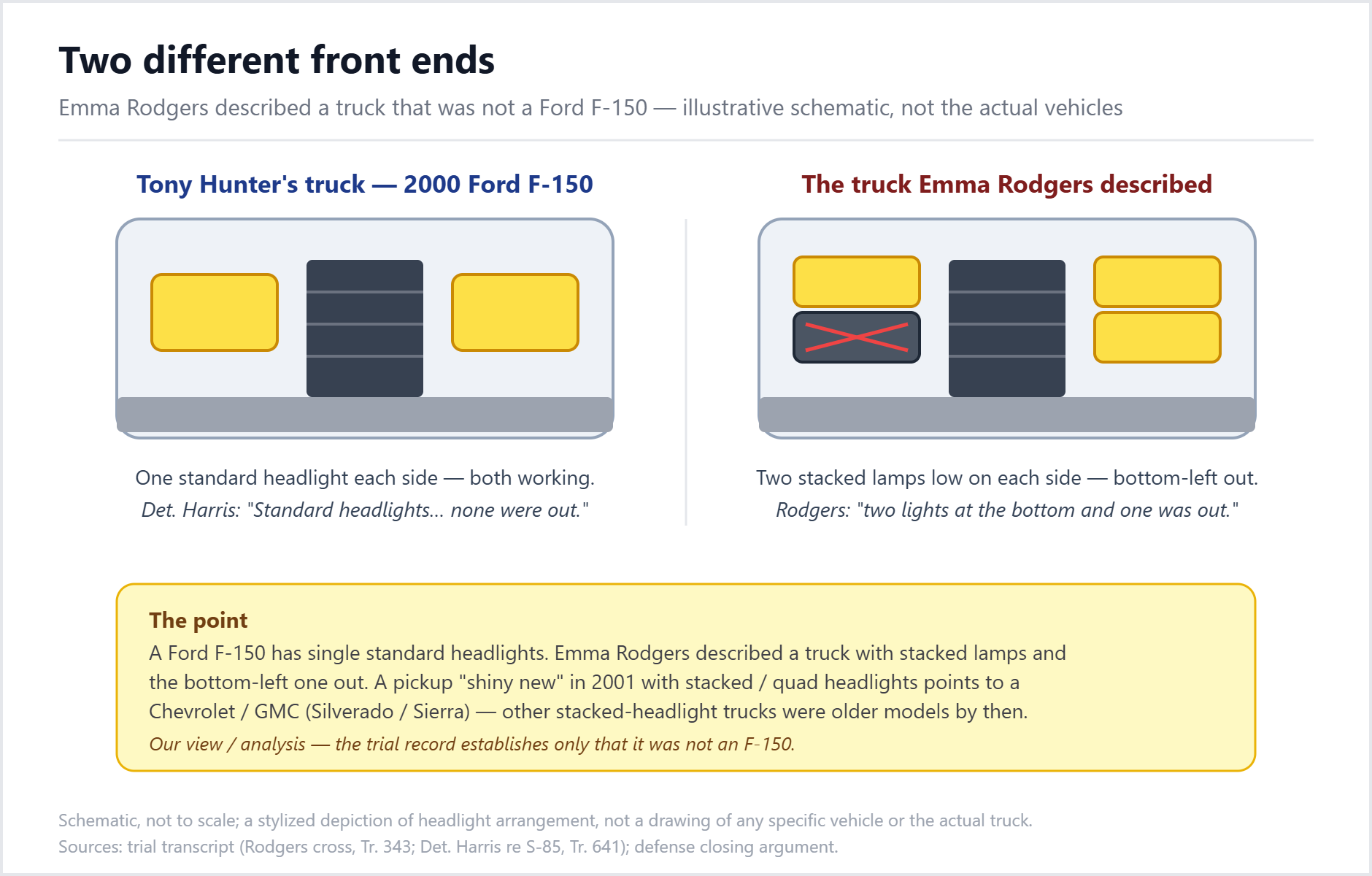
But her description of that truck does not match Mr. Hunter’s Ford F-150. Asked on cross how many lights it had — “the dual lights or one light?” — she answered: “It was the two (2) lights at the bottom and one was out… I just know at the bottom that one light is out,” which she believed to be the left. (Trial transcript at 343.) She told police the same thing: the truck had “a double-lamp setup at the bottom, and one of those lamps was not working,” and she thought “if I had been driving without a working headlight, I would have gotten a ticket.” (Emma Rodgers statement to OPSO.)
A Ford F-150 is not built that way, and Mr. Hunter’s had no light out. Shown the photograph of the seized F-150 (State’s Exhibit S-85), Detective Harris testified:
Q. “did it have any defective head lamps on it?”
A. “No, sir. I specifically inspected the head lights. They were all working… None were out.”
Q. “Did the lamp on that truck have any kind of double deck on them… They were not stacked on top of each other or anything like that?”
A. “No, sir. Standard headlights.”(Trial testimony of Detective Harris, at 641.)
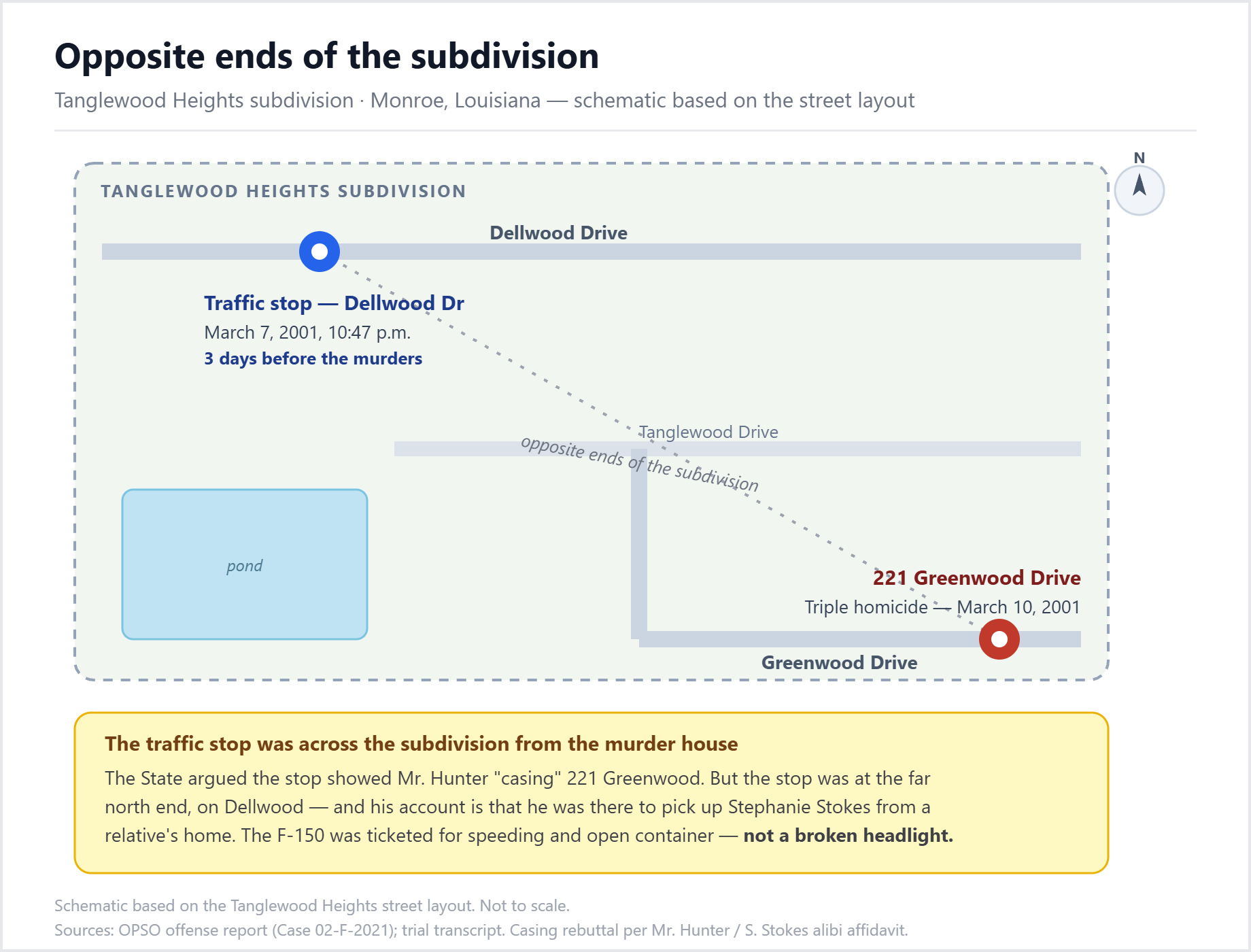
The truck’s lights were also documented as working three days before the homicides. On March 7, 2001 — the day Mr. Hunter leased the F-150 — an OPSO sergeant stopped him in it at 10:47 p.m., in the same Tanglewood subdivision as Greenwood Drive, and cited him for speeding and an open container. He was not cited for a malfunctioning headlight. (Louisiana Uniform Traffic Ticket #5657208; trial testimony. R. 2081.)
In closing, the defense put the two together: Emma Rodgers “indicated that the vehicle had a double stack of headlamps [and]… a missing headlamp,” but the photograph of Mr. Hunter’s truck shows no missing or damaged lamp. “So, was Ms. Rodgers mistaken about the truck that she saw being the same truck that she later saw Tony Hunter in? The evidence certainly seems to suggest that.” (Defense closing argument.)
The clothing and the DNA
Items of Mr. Hunter’s clothing were collected from his apartment, including a sweater and a shirt that “appeared to have blood stains on them,” and were sent to Gene Screen for testing. R. 2101. The State’s own investigative file records the result: the apparent blood on a yellow “Polo” sweater was not the blood of Levi Williams, Chavez Staten, or Jeremy Staten, and no blood was found on the other items submitted. (OPSO Narrative #48, results received by mail February 11, 2002; offense report attached to the State’s Answer filed July 31, 2003.)
The Gene Screen report is dated January 30, 2002. Mr. Hunter’s post-conviction filings describe its testing as excluding him from any connection to the murder scene, the victims, and the alleged murder weapon; what the investigative file itself records is set out above.
On when the State received the result, the record shows two dates that are two different things. OPSO Narrative #48 — the report documenting receipt — is dated February 11, 2002 and records that Sgt. Medaries received the Gene Screen results through the U.S. mail; the underlying receipt is placed at February 2, 2002. Both appear in the record: they are the narrative date and the receipt date, not a contradiction. (OPSO offense report, Narrative #48, attached to the State’s Answer filed July 31, 2003.)
The other half
The Second Circuit affirmed the conviction. On sufficiency it reasoned that the informants’ accounts were direct evidence of guilt rather than circumstantial, so the heightened circumstantial-evidence standard did not apply: “the jury in the case sub judice heard witnesses testify that they heard Defendant confess to committing the Greenwood Drive murders,” which it found sufficient to prove every essential element. State v. Hunter, 39,664, p. 5 (La. App. 2 Cir. 6/29/05); 907 So. 2d 200, 204, writ denied, 2005-2027 (La. 3/10/06); 925 So. 2d 507.
That holding is the pivot of this case, and readers should understand it: the absence of physical evidence was not disputed at trial, and it did not decide the appeal. What decided the appeal was whether a confession, testified to by three incarcerated witnesses, was enough on its own.
The same court, in the same opinion, described that testimony as “the evidence that directly linked Tony Hunter with the crime.” 907 So. 2d at 204.
Our view
The site’s own analysis.
In our view a case in which the State concedes there are no usable prints, no DNA, no fibers, no footprints, no tire tracks, and no ballistics connection carries an unusually heavy burden on the one remaining category of proof. Whether that burden was met is the subject of the jailhouse informants and the window.