By Mrs. Eileen Hunter — about the author. Posted August 11, 2026.
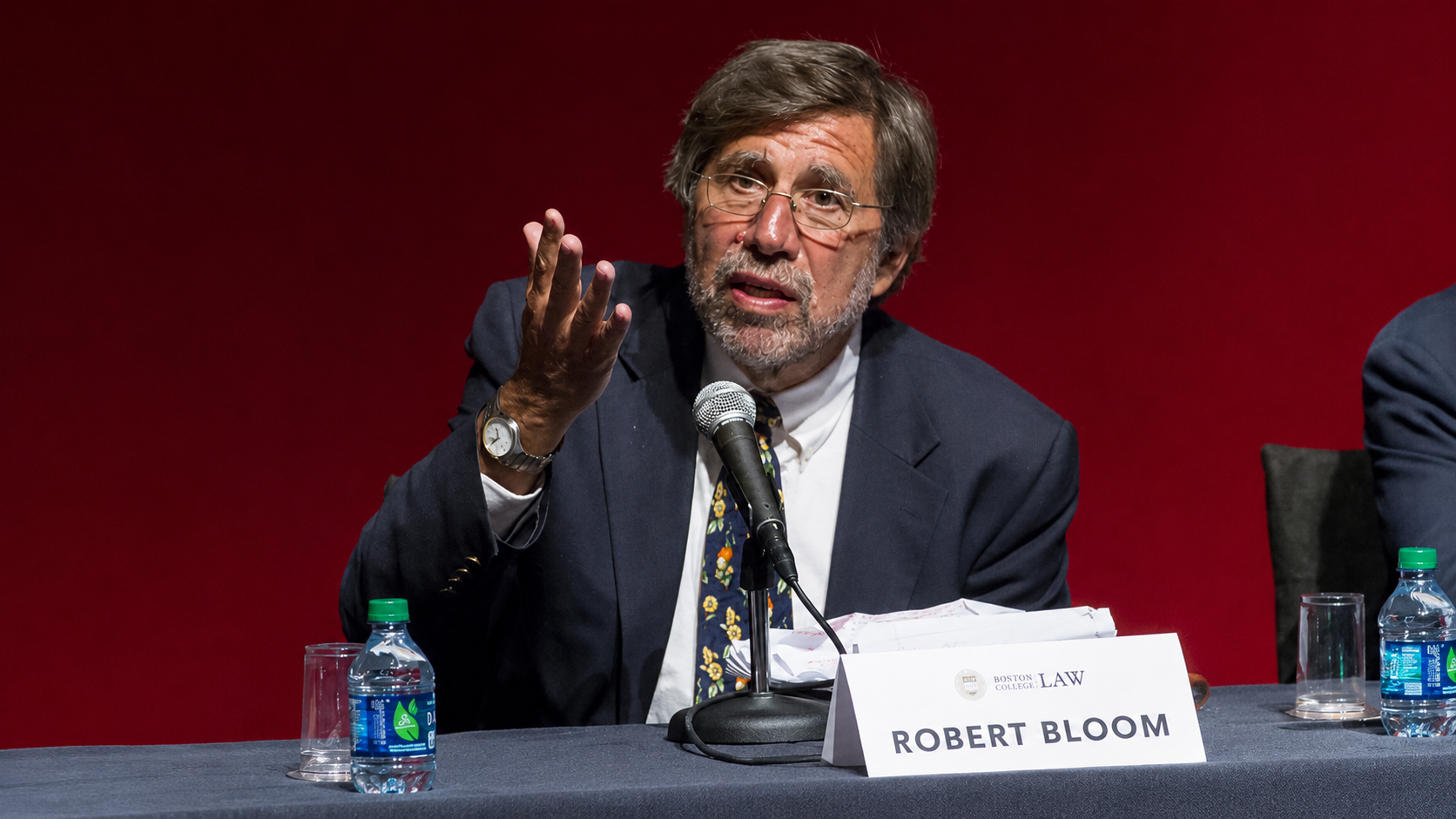
When Tony Hunter’s 2022 application for post-conviction relief needed an expert on jailhouse informants, it turned to one of the field’s longest-standing scholars. This page presents Professor Robert M. Bloom’s qualifications, what his research shows about informant testimony generally, and what he concluded — under penalty of perjury — after reviewing the record of State v. Hunter.
His full credentials, as sworn
The following are Professor Bloom’s qualifications exactly as he set them out, under penalty of perjury, in his declaration filed with Tony Hunter’s Application for Post-Conviction Relief on December 30, 2022 (Exhibit B-1, ¶¶ 1–3). The declaration is transcribed in full here.
Teaching and academic career
He has taught at Boston College Law School since September 1973, and has been a full professor since 1994. He has also taught at Boston University School of Law, Temple University School of Law (summer abroad in Rome), University College Dublin, Trinity College Dublin, and Kwansei Gakuin, Japan. His teaching includes courses in substantive criminal procedure and comparative criminal procedure. He has directed a law-school clinical program in which his students represented indigent criminal defendants, and on sabbatical he acted as a prosecutor for the Commonwealth of Massachusetts. In these capacities he has handled, supervised, or consulted on hundreds of criminal cases. He has written numerous articles, five casebooks, and ten Examples & Explanations books.
Research and publications on informants
Since 1999, he has researched the use of informants in the criminal justice system — reviewing numerous studies, investigations, and cases about informants in general and jailhouse informants in particular, and interviewing judges, prosecutors, and defense attorneys on the subject. His publications in this area include:
- a book, Ratting: Use and Abuse of Informants in the American Justice System (Praeger, 2002);
- “Jailhouse Informants,” in the American Bar Association publication Criminal Justice (Spring 2003); and
- “What Jurors Should Know about Informants: the Need for Expert Testimony,” Mich. St. L. Rev. 345 (2019).
He has lectured on jailhouse informants at an ABA Criminal Justice Section program (Baltimore, November 2005), and his publications have been cited on numerous occasions.
Experience as an expert witness
He has been retained as an expert or consultant on the issue of informants in approximately eleven cases. He has testified in Connecticut Superior Court on six occasions: State v. Covington (2016), State v. McClendon (2016), State v. Lashawn (2016), State v. Wilson (2017), and State v. Bruny (2018). He has also testified in the State of Washington in State v. Sun and State v. Rivas (2019) and State v. Phelps (2022), and at a pre-trial informant-reliability hearing in State v. Hammond (2014) in Lexington, Kentucky. He was prepared to testify in federal court in U.S. v. Wells (2019) in the U.S. District Court of Alaska. In each of these cases, he testified generally about the behavioral patterns associated with the use of criminal informants and the related academic research.
At the time of his declaration he was a consultant to the ACLU on a case out of Orange County, California concerning “informant tanks” — where people in custody are placed with informants likely to extract information for use at trial.
His jailhouse-informant expertise
Professor Bloom’s testimony never pronounces a particular witness truthful or false — it explains the recognized risk factors a fact-finder should weigh. From his declaration, the patterns his field has documented:
- Jailhouse informants played a role in nearly one in five DNA exonerations (Innocence Project); a 2004 Northwestern study found informant testimony in 45.9% of wrongful capital convictions. (¶ 5.)
- Informant testimony is “notoriously unreliable” yet uniquely persuasive — a claimed confession sways jurors more than almost anything, including eyewitnesses. (¶ 6.)
- Benefits usually arrive after testimony — letting informants testify that nothing was promised, and potentially keeping deals outside Giglio disclosure. “Everyone in the system knows how the game is played.” (¶¶ 8–10.)
- Informants gather convincing detail from media coverage, from relatives attending hearings, and from each other. (¶ 12.)
- Prosecutors lean on informants “particularly when it will shore up an otherwise weak case” — and studies show humans detect deception at barely better than chance. (¶¶ 13–15.)
- The ABA resolved in 2005 that “no prosecution should occur based solely upon uncorroborated jailhouse informant testimony.” (¶ 16.)
The subject of his review
In September 2022, Professor Bloom reviewed the testimony, recorded statements, and criminal histories of all four informants in State v. Hunter, plus contemporaneous press coverage. His declaration documents the claim-by-claim comparison — set out in full on the informants page — and notes that no cautionary jury instruction about informant testimony was ever given.
What it means for Tony Hunter’s case
Applying his expertise to what he reviewed, Professor Bloom reached a sworn conclusion:
“It is my opinion that the circumstances of this case, specifically the lack of external corroboration for the informants’ testimony, the media contamination of the informants, the number of cases the informants were providing information about and their status as career offenders facing lengthy sentences at the discretion of the prosecution, the informants’ perceived and/or real incentives to provide information against Tony Hunter and to testify falsely, and the failure to give a cautionary jury instruction, raise serious risks that the informants’ testimony was fabricated and/or false.”
(Declaration ¶ 18, sworn December 21, 2022.)
The limits, stated plainly
Professor Bloom is a retained defense expert, and his declaration is explicit that he “has not offered an opinion on the credibility of any particular informant in any particular case” — his role is identifying the risk factors a fact-finder should weigh. The application his declaration accompanied was denied without an evidentiary hearing; no court has heard his testimony in this case. (Procedural history.)
Related: the three informants, compared against the record · the individual files: Kennedy · Comanche · Wiggins · Nelson · case timeline.
Read the full informant record
Professor Bloom’s analysis is the expert lens; the underlying record is where his concerns become concrete. Continue to the jailhouse informants page — the master account of the three men whose testimony convicted Tony Hunter, measured claim by claim against the trial record — and to the individual evidence files it links: Clarence Kennedy, Vaccara Comanche, Christopher Wiggins, and Glen Dale Nelson. His declaration itself is transcribed in full in the case documents.