By Mrs. Eileen Hunter — about the author. Posted August 8, 2026. Last updated August 9, 2026.
What the record shows
No physical or forensic evidence connected Mr. Hunter to 221 Greenwood Drive. What the State presented at trial instead was the testimony of three men incarcerated at the Ouachita Parish Correctional Center — Vaccara Comanche, Clarence Kennedy, and Christopher Wiggins — each of whom said Mr. Hunter had confessed. (These are the three witnesses who testified; the investigation’s files reflect other statements, but three men took the stand.)
Individual evidence files: Clarence Kennedy · Vaccara Comanche · Christopher Wiggins · Glen Dale Nelson · Professor Bloom’s analysis · case timeline.
The Louisiana Second Circuit, affirming the conviction on direct appeal, described that testimony as
“the evidence that directly linked Tony Hunter with the crime.”
State v. Hunter, No. 39,664, p. 5 (La. App. 2 Cir. 6/29/05); 907 So. 2d 200, 204, writ denied, 2005-2027 (La. 3/10/06); 925 So. 2d 507.
Each of the three testified that he had been promised nothing.
The reward, and when the statements came
The statements did not come first. They came after the money did.
Captain Harris testified that in the months after the killings the investigation had run into “a brick wall because nobody would talk.” Asked whether he had offered a financial incentive for information, he answered: “Yes sir. Cash money.” The Sheriff’s Office publicized reward money in addition to a $2,000 Crime Stoppers reward, and by March 2002 the department was telling the local newspaper that leads had “totally dropped off” and that “no one is wanting to come forward.” (Trial and bond-hearing testimony of Captain Harris; newspaper account, March 11, 2002.)
What changed after that was not the discovery of physical evidence. On June 12, 2001, a KTVE broadcast named Mr. Hunter in connection with the killings; the reward was known; and statements began to arrive. The three men who testified gave their recorded statements on July 20, August 2, and August 20, 2001 — after the publicity and the reward, not before. (Broadcast records; recorded statements.)
The expert who reviewed it: Professor Robert M. Bloom
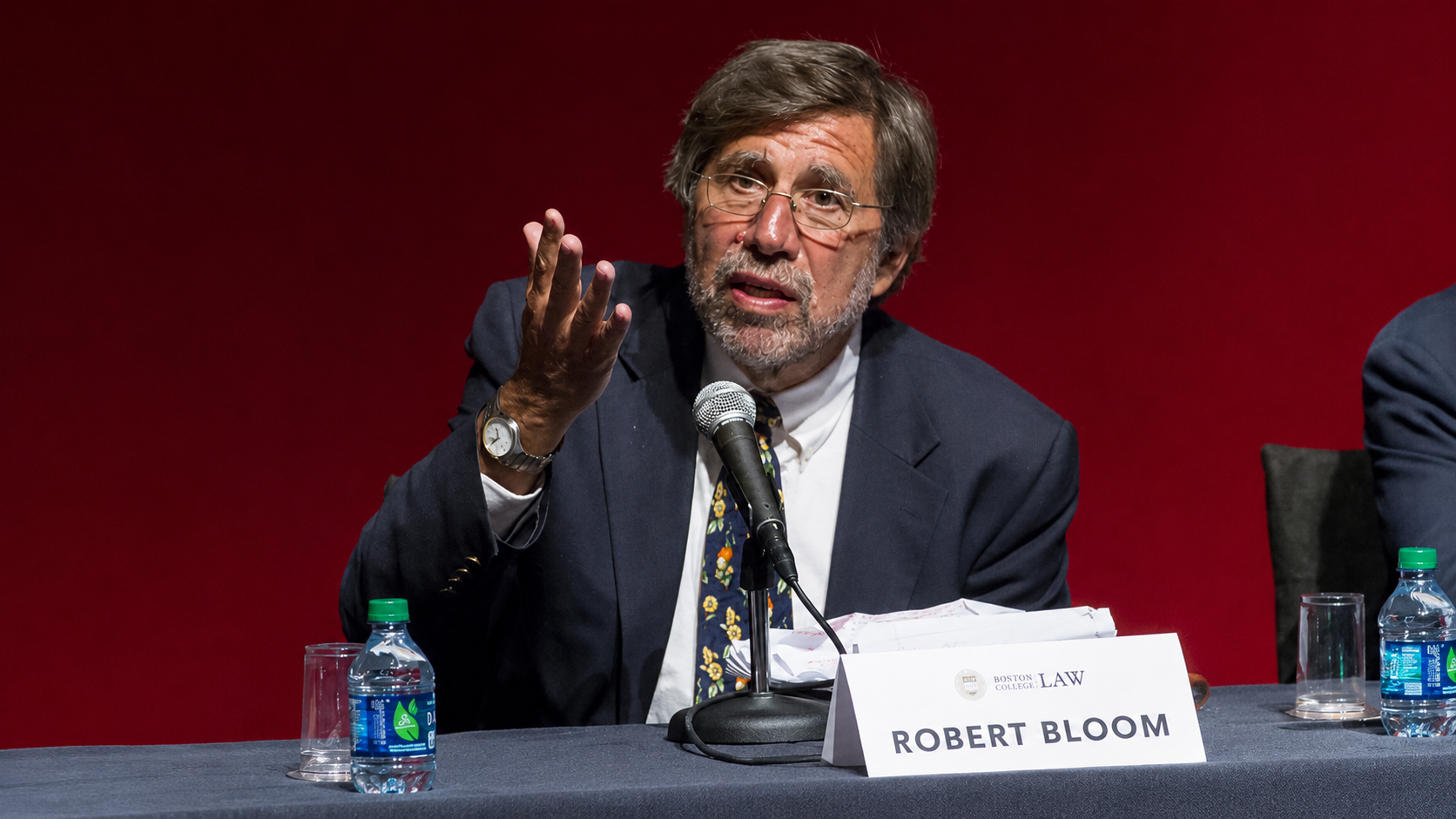
The 2022 application for post-conviction relief attached the sworn declaration of Robert M. Bloom, Professor of Law at Boston College Law School — on its faculty since 1973, a full professor since 1994, and a researcher of informant use in the criminal justice system since 1999. He is the author of Ratting: Use and Abuse of Informants in the American Justice System (Praeger, 2002) and “What Jurors Should Know about Informants: the Need for Expert Testimony,” Mich. St. L. Rev. 345 (2019), and has testified as an expert on informants in Connecticut, Washington, and Kentucky courts — six Connecticut Superior Court trials among approximately eleven cases in which he has been retained as an expert or consultant; at the time of his declaration he was also consulting for the ACLU on the use of “informant tanks” in Orange County, California. His declaration is careful about its own limits: “I have not offered an opinion on the credibility of any particular informant in any particular case.” (Declaration of Robert M. Bloom, ¶¶ 1–3, Exhibit B-1 to the Application for Post-Conviction Relief filed December 30, 2022, sworn December 21, 2022.)
What the declaration does set out is what the research shows. According to the Innocence Project, jailhouse informants played a role in nearly one in five of the 367 DNA-based exoneration cases; a 2004 Northwestern study found informant testimony in 45.9 percent of wrongful capital convictions; the National Registry of Exonerations puts jailhouse informants in 22 percent of all death-row exonerations. (Bloom Decl. ¶ 5.) Such testimony, he writes, is “notoriously unreliable” yet “among the most persuasive to jurors,” because informants “typically allege to have personally heard defendants confess” — and one study found secondary confession testimony sways jurors more than eyewitness identification. (¶ 6.) “It is hard to imagine a greater incentive to testify falsely than a promise to get out of jail or reduce one’s time in prison.” (¶ 8.)
“In most instances, the benefits for informant testimony are not realized until after the testimony has been given. This arrangement allows an informant to testify that there were no promises or benefits given in return for his testimony. The withholding of specific promises until after the testimony may also allow a prosecutor to avoid the disclosure requirements of Giglio v. United States.”
(Bloom Decl. ¶ 9.)
Set that paragraph beside this page’s timeline: Comanche’s habitual-offender bill, dismissed thirty-nine days after Mr. Hunter’s indictment; Kennedy’s twenty suspended years. The pattern Professor Bloom describes in general terms is the pattern the records of this case document in particular.
And his conclusion about this case, sworn under penalty of perjury:
“It is my opinion that the circumstances of this case, specifically the lack of external corroboration for the informants’ testimony, the media contamination of the informants, the number of cases the informants were providing information about and their status as career offenders facing lengthy sentences at the discretion of the prosecution, the informants’ perceived and/or real incentives to provide information against Tony Hunter and to testify falsely, and the failure to give a cautionary jury instruction, raise serious risks that the informants’ testimony was fabricated and/or false.”
(Bloom Decl. ¶ 18.)
We report the reward and the sequence, because both are in the record. We do not assert in the site’s own voice that any witness testified falsely to obtain money — that conclusion, to the extent we draw it, is set out under “Our view” and rests on the facts on this page.
Vaccara Comanche
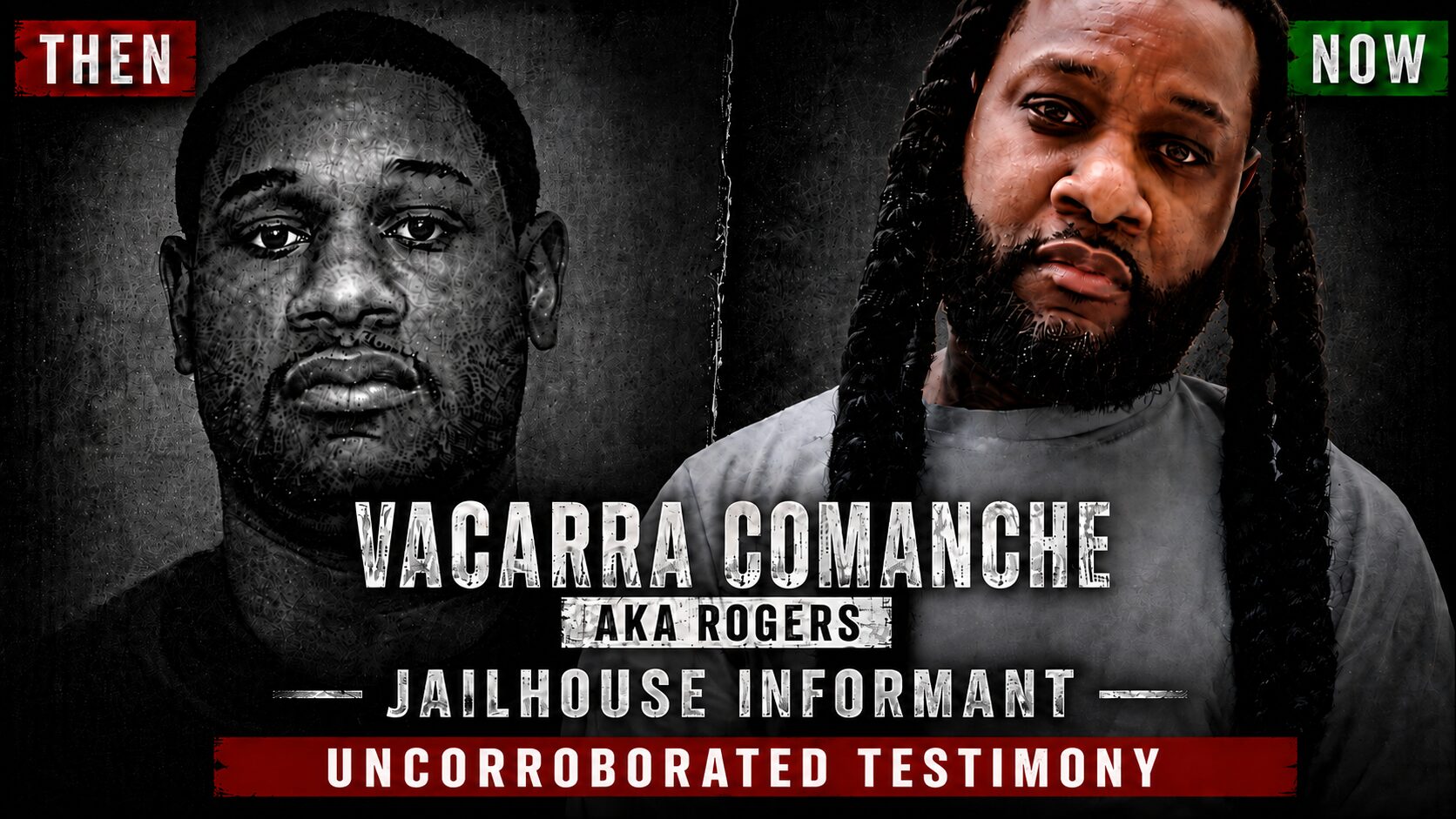
Comanche gave a recorded statement to the Ouachita Parish Sheriff’s Office on July 20, 2001. He said he had overheard Mr. Hunter speaking with another inmate, Glen Dale Nelson, through a Pod 10 window, and that Mr. Hunter had described the killings.
What changed between the statement and the stand
In his July 2001 statement, Comanche told investigators he was on the bottom bunk behind a blanket and that neither man knew he was there. At trial he testified he had followed Nelson into the cell and sat beside him on the top bunk. Asked whether Mr. Hunter knew he was sitting there, he answered: “Quite naturally. I’m sitting right beside him.” Later he testified it had not been one conversation but several: “sometimes he knew I was right there beside him and sometimes he didn’t know I was there.” R. 1972.
On the time of day, he told investigators 8:00 or 9:00 a.m.; at trial he said between noon and 3:00 p.m. (Defense closing argument, trial transcript.)
He was assisting law enforcement in more than one case
Detective Medaries testified that Comanche gave two separate recorded statements on July 20, 2001 — one “relative to information he had regarding the killings on Greenwood,” and another concerning “information he was going to provide us in an unrelated case that we were working.” R. 1989.
What the jury was told
The State presented Comanche to the jury as a two-time felony offender serving ten years for possession of a firearm by a felon, with one prior conviction for aggravated battery, and elicited his testimony that he had been promised nothing in exchange for his cooperation. (Trial testimony.)
What the jury was not told
Counsel obtained the sentencing transcripts, Ouachita Parish clerk’s minutes and habitual-offender documentation on March 27, 2025. Those records set out the following sequence.
| Date | What the records show |
|---|---|
| 2001-05-04 | Mr. Hunter arrested |
| 2001-07-20 | Comanche interviewed; gives his statement about Mr. Hunter |
| 2002-02-20 | Comanche sentenced to ten years at hard labor without benefit of parole, probation or suspension, possession of a firearm by a felon, No. 2000-F-1473, before Judge Sharon Marchman (clerk’s minutes, 02/20/2002) |
| 2002-03-05 | State dismisses Comanche’s Schedule II drug charge, No. 2000-F-303 (see below — this entry is the anomaly) |
| 2002-04-15 | Comanche sentenced on five counts of simple burglary, No. 2000-F-1474, six years per count concurrent, before Judge Carl Van Sharp. The habitual offender bill is filed the same day |
| 2002-10-17 | Mr. Hunter indicted |
| 2002-11-25 | The habitual offender bill is dismissed without prejudice — thirty-nine days after the indictment (clerk’s minutes, 11/25/2002) |
| 2004 | Comanche testifies at Mr. Hunter’s trial, after the bill was dismissed |
The March 5, 2002 minute entry
The clerk’s minute entry dismissing Comanche’s Schedule II drug charge reads, in full:
“Case dismissed as per conviction and sentence in 00F-1473 and 00F-1474, per written Motion to Dismiss filed.”
(Clerk’s minutes, State v. Comanche, No. 2000-F-303, 4th JDC, Parish of Ouachita, March 5, 2002.)
On March 5, 2002, No. 2000-F-1474 had not been sentenced. The same set of clerk’s minutes records that sentencing as occurring on April 15, 2002 — six weeks later.
We report both entries and leave the reader to weigh them. Both are certified clerk’s records of the same court.
The November 25, 2002 minute entry
“Hon. Robert S. Noel, II present and the State dismissed matter without prejudice. Habitual Offender Bill filed.”
(Clerk’s minutes, State v. Comanche, No. 2000-F-1474, November 25, 2002.)
The minute entry for that date lists Judge Carl Van Sharp presiding and, among the assistant district attorneys present in court, J. Michael Ruddick — who prosecuted Mr. Hunter at trial.
What the sentencing judge and the prosecutor said, on the record
At the April 15, 2002 plea and sentencing hearing before Judge Carl Van Sharp, with Assistant District Attorney Geary S. Aycock appearing for the State:
THE COURT: “I looked at his PSI and my eyebrows kind of went up. He was kind of bought and paid for on this — how long is he looking at…”
Later in the same hearing, reviewing the criminal history:
THE COURT: “This is what confused me, the Court has before it for sentencing a twenty-one-year old black male, second felony offender, who has pled guilty to five counts of Simple Burglary. That’s a mistake; isn’t it?”
MR. AYCOCK: “That’s a mistake.”
THE COURT: “Do you agree?”
MR. COMANCHE: “That that’s a mistake?”
THE COURT: “Yeah. You’re not a two-time felony offender. You are a four-time felony offender; is that correct?”
MR. COMANCHE: “Not to my knowledge.”
(Plea of Guilty and Sentencing Transcript, April 15, 2002, State v. Comanche, No. 2000-F-1474, 4th JDC, Parish of Ouachita, at 12; Bates Hunter 012239.)
The court then said, “Well, let’s go through it. I don’t want to make a mistake here,” and walked the criminal history on the bench with both counsel — the 1997 arrests pled in 1999, the aggravated battery, the probation revocation, the firearm conviction. Two pages later it reached the count:
THE COURT: “There’s two felony convictions. Then we have August 7, ’00, plea of guilty or found guilty on 2/21/02. You picked up ten years on it? Possess of a Firearm by a Convicted Felon.”
MR. AYCOCK: “Correct.”
THE COURT: “…Previous to his conviction. All right. That’s three felonies.”
(Same transcript, at 14; Bates Hunter 012241.)
The count moved three times in one hearing. The presentence report before the court classified Comanche as a second felony offender. The prosecutor agreed on the record that this was “a mistake.” The court’s first reading of the history put him at four. After going through the record with both counsel, the court settled on three felonies.
At Mr. Hunter’s trial two years later, the jury was told Comanche was a two-time felony offender — the figure the sentencing court and the prosecutor had already agreed was a mistake.
Earlier in the same hearing, Mr. Aycock described the condition attached to the habitual offender bill:
“…whether or not I would file a habitual offender, although, I’ve said if his firearm charge stands, then I probably wouldn’t proceed with it.”
(Same transcript, at 5; Bates Hunter 012232.)
None of that was before the jury at Mr. Hunter’s trial. It was said in a different courtroom, in Comanche’s own case, two years earlier.
The claim now before the courts
The application filed in 2026 alleges the State suppressed impeachment evidence about Comanche in violation of Brady v. Maryland, Giglio v. United States and Napue v. Illinois — specifically his undisclosed felony record, his habitual-offender exposure, his favorable treatment, and his denial of any benefit. The application identifies three distinct benefits: dismissal of the cocaine charge; a six-year sentence on five burglary counts; and dismissal of a habitual-offender bill that exposed him to life imprisonment.
The filing does not argue a formal deal is required. It relies on Tassin v. Cain, 517 F.3d 770, 780 (5th Cir. 2008) — “the crux of a Fourteenth Amendment violation is deception. A promise is unnecessary” — and LaCaze v. Warden, 645 F.3d 728, 736 (5th Cir. 2011).
This has happened in Louisiana before
Readers sometimes assume a claim like this is unusual. It is not.
In Weary v. Cain, 577 U.S. 385 (2016), the Supreme Court of the United States summarily reversed a Louisiana conviction where the State had failed to disclose that its jailhouse-informant witness had a documented history of providing information to law enforcement in exchange for consideration in his own cases. The Court held the suppressed impeachment evidence undermined confidence in the verdict, because that informant’s testimony was central to the State’s case.
The writ application filed on July 9, 2026 argues the parallel to Comanche is direct: an informant whose own criminal exposure was being managed by the same prosecuting authority he was assisting, with that pattern concealed from the jury.
Clarence Kennedy
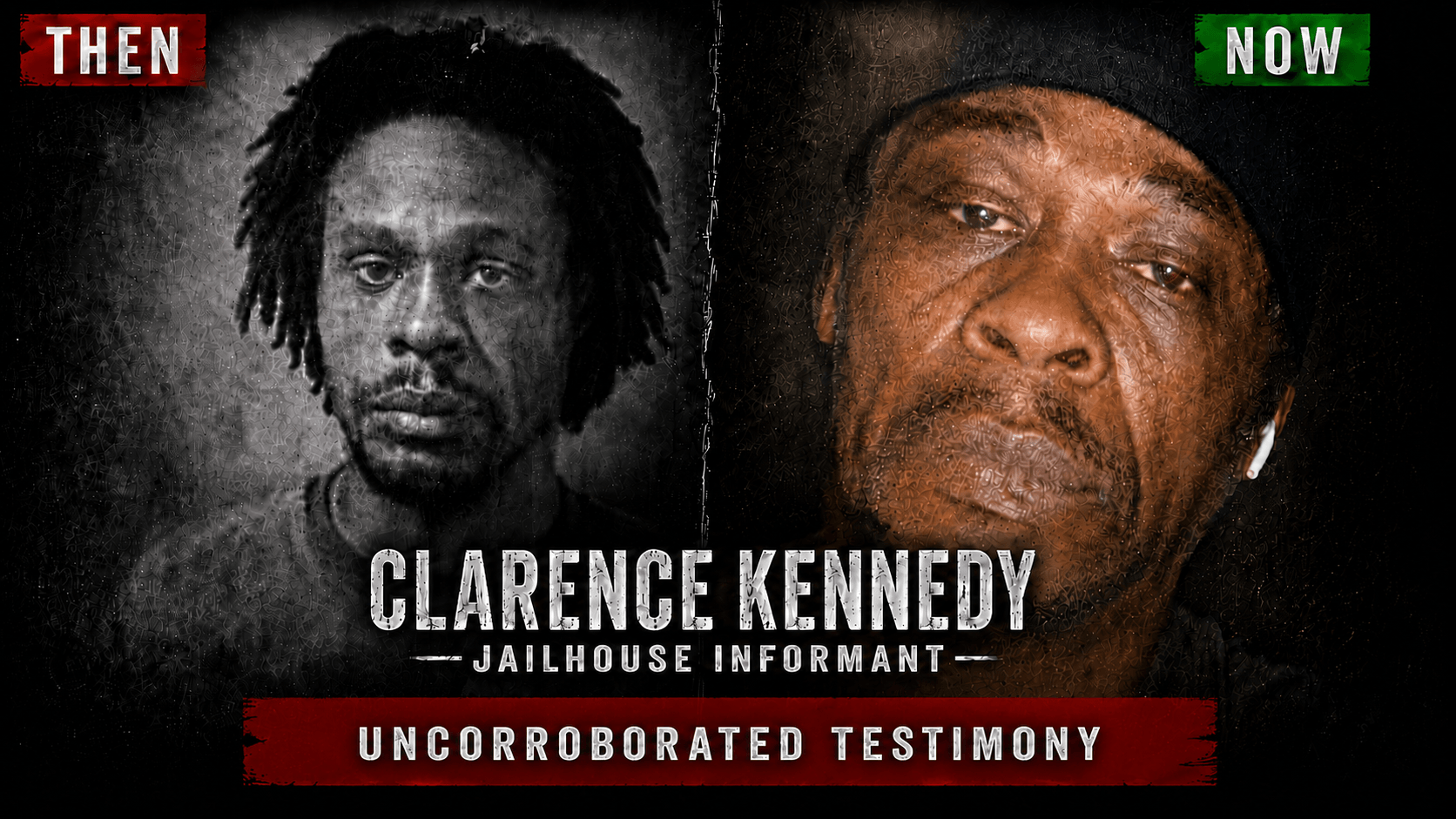
Kennedy asked to speak to a deputy on August 20, 2001. He said that around the first week of August he was in his cell in 10C, heard knocking on the window, looked out and saw Mr. Hunter on the recreation yard, and was told to go get Glen Dale Nelson. R. 199, 2149.
At trial he testified that he heard Mr. Hunter ask Nelson “what did you say, because the police know too much,” R. 200, and heard him describe the killings. He testified that Jody Rucks was on the top bunk during the conversation. He testified he had not been promised anything, R. 2151, that he came forward because it “really hurt him” to hear it, and that he and Mr. Hunter were not friends and he did not like him. R. 2162. He denied asking the State for help with his sentence. R. 2164.
The sentence. Kennedy pled to first-degree robbery, and he was sentenced to twenty-five years with twenty suspended. (Court records, No. 01-F-0649; plea and sentence minute entries, Exhibit H-3 to the Application for Post-Conviction Relief filed December 30, 2022.)
La. R.S. 14:64.1 provides that whoever commits first-degree robbery “shall be imprisoned at hard labor for not less than three years and for not more than forty years, without benefit of parole, probation or suspension of imposition or execution of sentence.”
The statute forbids suspension for that offense. Twenty years of the sentence were suspended. This contradicted Kennedy’s testimony that he received no benefit.
The burglary charge, and the sequence around it.
| Date | Event |
|---|---|
| 2002-01-30 | The Gene Screen report is dated. It excludes Mr. Hunter from the scene, the victims and the weapon |
| 2002-02-02 | The State receives the report |
| 2002-02-10 or 11 | Kennedy speaks with a defense investigator about the case; at trial he denied receiving any deal. Tr. 605 |
How it reached the jury. According to the 2022 application for post-conviction relief, the exchange at trial went:
MR. RUDDICK: “Now, Mr. Kennedy, other than the sentence that you’re presently serv[ing] for the first — you’re serving for the first degree robbery, you have been convicted of other felonies? Is that [correct]?”
KENNEDY: “Yes, sir. Correct.”
MR. RUDDICK: “And is simple burglary one…?”
KENNEDY: “Correct.”
(Application for Post-Conviction Relief Based on Factual Innocence, 4th JDC, filed December 30, 2022, ¶ 112; trial transcript at 592.)
The simple burglary charge was before the jury as a conviction. The records show it had been dismissed pursuant to a plea agreement before trial.
Christopher Wiggins
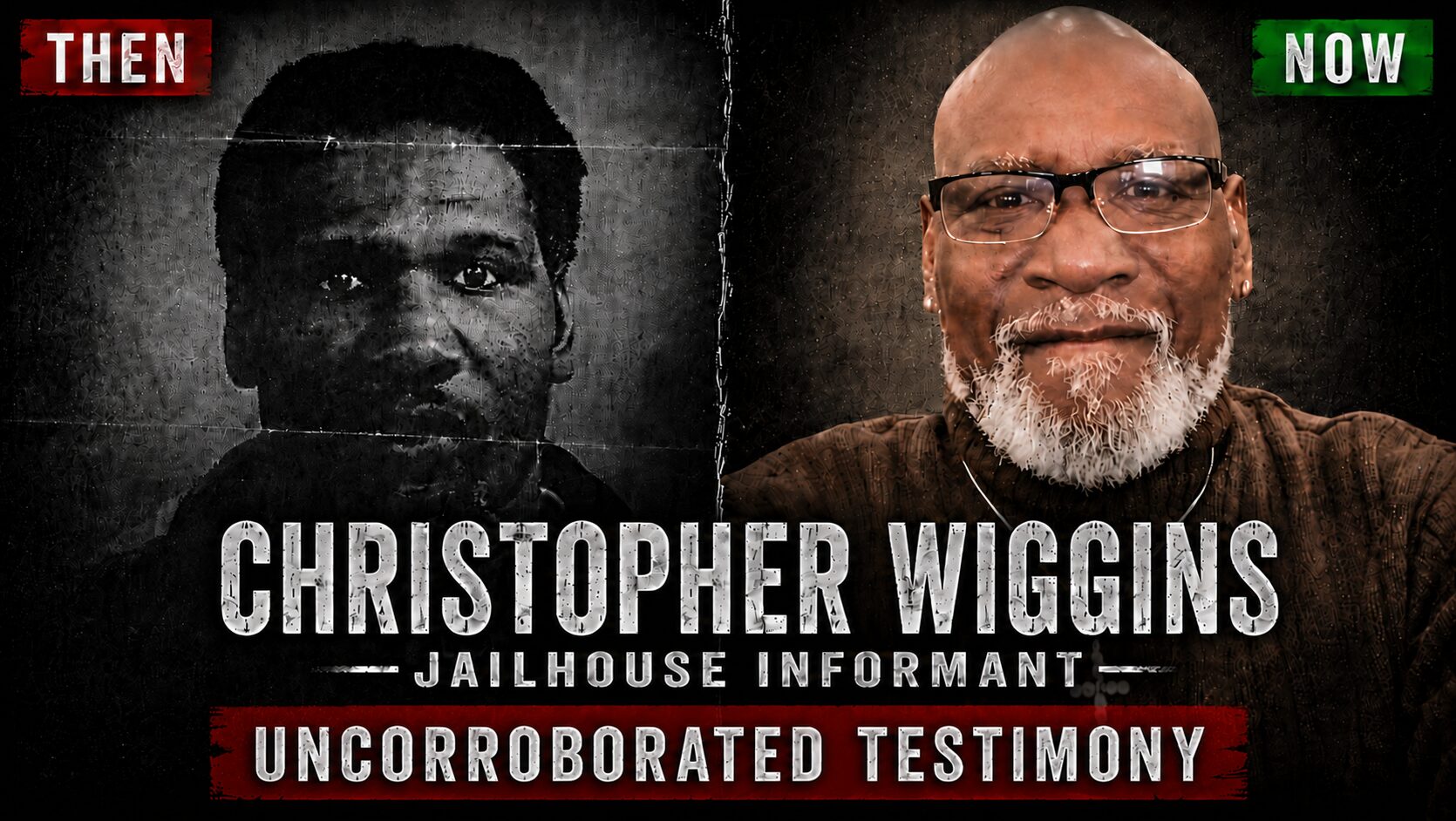
Wiggins did not come forward, and he did not want to testify. Captain Harris testified that investigators sought him out; he had been housed in a two-man isolation cell with Mr. Hunter for about two months, having been placed in isolation for gambling. R. 2134.
Called by the State, Wiggins refused to be sworn. Asked to take the oath, he answered: “I ain’t testifying. I ain’t testifying.” With the jury removed, the court had him brought back; he refused the oath again. The court then directed him to the stand and, when he hesitated, admonished him: “Don’t act so stupid. You knew exactly where to go. You’ve been in the witness stand before.” The court told him he had “no Fifth Amendment Right to refuse to testify,” and — after a conference in chambers — ordered him held in the courthouse until released. He was brought back and testified the following day. (Trial transcript, R. 2086–2087.)
His testimony, in short, was compelled from a practiced witness — one the court noted had “been in the witness stand before” — who had just refused to give it under oath.
On the stand he testified that Mr. Hunter told him he kicked a door in and committed a robbery in the Tanglewood area that “lead to three people being killed,” and that the children “seen his face upon him leaving out the house and he couldn’t leave no witness behind so he had to kill them.” R. 2130. He testified that Mr. Hunter said he used a .38 and a 9 millimeter. R. 2139.
The weapon recovered and identified at trial as the murder weapon was a .22 caliber semi-automatic. Comanche testified he heard the weapon referred to as a “.22.” Wiggins testified it was a .38 and a 9 millimeter. (See “The accounts did not match,” below.)
Wiggins admitted that, after he was taken out of court, he asked the District Attorney’s Office for leniency on his sentence. R. 2131. He had five felony convictions, including manslaughter, and faced a life sentence if the State filed a multiple offender bill. R. 2135. It did not.
Wiggins later recanted. In an interview with a defense investigator on March 29, 2014, Wiggins denied that Mr. Hunter had ever confessed to him; said he had been promised a reduction of his sentence that the State did not honor, so that he served the full four and a half years he had left; and said that if Mr. Hunter obtained a new trial, he would testify that Mr. Hunter never confessed to him. He declined to sign an affidavit, saying he could be charged with perjury. (Interview with investigator Jack Pierce, March 29, 2014, Exhibit I-3 to the application for post-conviction relief filed December 30, 2022.)
And in July 2022, according to the filed Bloom declaration, Wiggins went further. The declaration recounts that Wiggins told an investigator for Mr. Hunter that officers approached him in 2001 at the Ouachita Correctional Center and “asked to wear a wire and to try to entrap Tony Hunter into confessing to the Tanglewood homicides. He refused. The officers then asked him to say that he heard Tony Hunter confess to the homicides and he agreed. He told the investigator that he has carried guilt about lying in his testimony against Tony Hunter for the past 25 years.” (Declaration of Robert M. Bloom, Exhibit B-1 to the Application for Post-Conviction Relief filed December 30, 2022, reporting the July 2022 investigator interview.) That account is Wiggins’s, as relayed in a filed sworn declaration; no court has ruled on it.
The accounts did not match
The application now before the Second Circuit describes the trial evidence this way: the testimony of three jailhouse informants “whose accounts contradicted each other and other witnesses and were uncorroborated by any other evidence.” (Application for Supervisory Writ, Second Circuit, filed July 9, 2026, at 5.) The trial record bears the description out. Comanche and Kennedy claimed to have overheard the same jailhouse conversation — and described it differently at nearly every turn.
Which cell, and who was in it. Comanche testified he overheard the conversation from a ten-man cell, with “four or five” other men present — he named Henry McGraw and Simeon Herbert — “either laying down listening to their radios or asleep.” Kennedy testified it happened in his own cell, where the only other person was Jody Rucks, asleep on the bunk above him. Neither man placed the other in the room. (Comanche, trial transcript at 388; Kennedy, at 597–598.)
Who was on the yard. Comanche testified Mr. Hunter was outside “with the other two inmates [who] was in isolation with him.” Kennedy was asked directly, “Just Mr. Hunter by himself?” — and answered: “Yeah. That’s all I seen.” (Comanche at 391; Kennedy at 599.)
What was said about the gun. Comanche testified he heard Mr. Hunter refer to “a .22.” Kennedy, asked “Did you hear him mention any weapons?”, answered “No, sir” — and said he heard no names and no dates either. The third witness, Wiggins, testified the guns were “a .38 and a 9 millimeter.” The weapon in evidence was a .22. (Comanche at 385; Kennedy at 602; Wiggins, R. 2139.)
Kennedy heard no names — until he did. Just after testifying “You never heard him mention any names during this so called conversation? correct?” — “Correct,” Kennedy said Mr. Hunter “shot Levi, I mean, ah, Chico… in the room.” Asked, “I thought you earlier said that you didn’t hear him mention any names?”, he answered: “Any names? He didn’t say no name.” (Trial transcript at 602.)
Comanche’s account shifted over time. In his July 20, 2001 statement he placed the conversation at 8:00 or 9:00 in the morning; at trial, between noon and 3:00 in the afternoon. In his statement he said he was on a bottom bunk behind a blanket and neither man knew he was there; at trial, that he sat on the top bunk beside Nelson, in Mr. Hunter’s view — then, confronted with the difference, that it had been not one conversation but several, on different days and in different cells: “sometimes he knew I was right there beside him and sometimes he didn’t know I was there.” R. 1972.
And the detectives contradicted him. When Comanche testified that investigators had taken “two to three” recorded statements from him about this case, both said otherwise. Detective Medaries testified, “We only took one recorded statement from him regarding the killings on Greenwood,” and that Comanche’s version “would not be a true statement.” Captain Harris, asked the same, answered: “No, sir. That’d be incorrect.” (Medaries, trial transcript at 437; Harris, at 445.)
These are reports of what each witness said, set side by side — against one another and against the State’s own detectives. We draw no conclusion here about anyone’s truthfulness; the contradictions are on the face of the record, and readers can weigh them.
The man they said heard the confession
Glen Dale Nelson — the inmate to whom the alleged confession was made — was never called to testify. Michael Ruddick, the prosecuting attorney, later swore an affidavit stating he did not call Nelson because “he was totally unreliable, and it appeared he would say anything that he thought would help him with his various legal problems.”
In State v. Hill, 601 So. 2d 684, 688–89 (La. Ct. App. 1992), writ denied, 608 So. 2d 192 (La. 1992), Nelson testified for the prosecution that a different defendant had confessed to him at the same jail. In State v. Stokes, the State moved to bar Nelson from testifying for a defendant, and the Louisiana Supreme Court affirmed, holding that “the district court judge totally discredited the testimony of Nelson.” State v. Stokes, 2003-KK-0556 (La. 2/28/2003).
Nelson and Mr. Hunter were enemies. At Mr. Hunter’s bond-reduction hearing, Detective David Harris testified that he had interviewed Nelson about several homicides, that Nelson denied any involvement, and that Nelson and Mr. Hunter had a history:
“He knew Tony Hunter, they were on the outs and even related at one point that they’d had an exchange of gunfire somewhere down on the south end. That they just weren’t buds, if you will. They were not friends.”
Harris also agreed that Nelson himself “referred to an incident of some shooting between the two.” (Bond-reduction hearing testimony of Detective Harris, at 116; Exhibit H to the application for post-conviction relief.) The two men were placed on each other’s “enemies lists” at the state penitentiary so they would not be housed together, and Mr. Hunter’s 2022 application states that on December 30, 2000 — about two months before the killings — Nelson fired two shots at him, citing a Monroe Police Department report. (Application for Post-Conviction Relief, 4th JDC, filed December 30, 2022, ¶119; Monroe Police OCA Complaint Report, December 30, 2000.)
Nelson’s efforts to implicate Mr. Hunter began well before any jailhouse informant came forward. On June 20, 2001, a woman named Sherry Hines gave a statement to the Sheriff’s Office relaying an account she attributed to Nelson that “Trigger” had committed the Greenwood killings — an account the record shows was contradicted by the physical evidence and the condition of the scene. Hines was never called at trial. She also told investigators that Nelson had threatened to kill her. (Sherry Hines statement, June 20, 2001, OPSO offense report, R. 156–169; Application for Post-Conviction Relief, 4th JDC, filed December 30, 2022, ¶¶50–51.)
Nelson had recanted a false accusation against Mr. Hunter once before. In a sworn affidavit dated July 26, 2001, Nelson stated that in February 2001 he had contacted the Ouachita Parish Sheriff’s Office with information implicating Mr. Hunter in a different homicide — the Roderick Hall homicide — and that the information was false. He swore he “only told Sergeant David Harris and the other Detective what they had wanted to hear, ‘So I could go home,’” that he had assembled the account “through friends and neighborhood gossip” and “what was said in the News Media… to implicate Tony Hunter and… free myself from incarceration,” that he had “never seen Tony Hunter with a gun,” and he apologized to Mr. Hunter and his family. (Affidavit of Glen Dale Nelson, July 26, 2001, Exhibit J-4 to the Application for Post-Conviction Relief filed December 30, 2022.) Mr. Hunter was arrested in the Roderick Hall case but never indicted.
On January 31, 2012, Nelson swore a second affidavit stating the accounts against Mr. Hunter were “a jailhouse conning scheme organized by my friends, Vaccara Comanche and Clarence Kennedy.”
Current counsel interviewed him on February 27, 2026. The transcript is filed as Exhibit 2 to the application for post-conviction relief filed March 26, 2026 — so Nelson’s account is now in the public court record, in his own words. He says the first time he learned what Comanche and Kennedy had told police was the week trial began, when his own lawyer came to see him because “the DA wanted me to testify”:
“I said, ‘I don’t know nothing about that.’ He said, ‘Well, let me read something to you.’ So that’s when he read me Comanche’s and Kennedy’s statement. I was like, ‘Man… It ain’t happening. I don’t want nothing to do with that. I ain’t messing with that.’ And that’s why I took the Fifth.”
(Recorded interview of Glen Dale Nelson by counsel, February 27, 2026, Exhibit 2 to the Application for Post-Conviction Relief filed March 26, 2026.)
On the confession itself, Nelson says in the same interview: “[T]hose guys stated that Hunter made a confession in the presence of me and some other people. That didn’t happen… When I asked my attorneys to bring me the statements that was made, I was like, ‘Wow, this never happened.’ But they said it did, but it didn’t.” Of the accounts that reached the jury: “that seemed to be what convicted him… Comanche and Clarence Kennedy… But they fabricated that. That didn’t happen.” He acknowledges he and Mr. Hunter did speak — but describes it as him relaying a message investigators had given him: “I said, ‘Well, they told me to tell you they got you, bro.’ And that was basically the conversation.”
Why he stayed silent at trial, in his own words. “I was fighting charges myself and by pissing off the district attorney at that time, that wasn’t a good idea for me either… So I pled the Fifth.” He says he “had a homicide charge pending then, another charge Tony Hunter and I had that was dismissed against Tony, but they kept it over my head, I guess for some leverage or something.” Asked whether there was an offer on the table if he testified: “Well, somewhat, yeah… I was told that if I did, that everything was going to kind of go away. But I didn’t deal with it. I just didn’t want no part of that stuff. That was heavy… it was dangerous.” His attorneys told the State that if called, he would invoke the Fifth Amendment. (Exhibit 2, same interview.)
The jury, meanwhile, heard nothing from or about Nelson’s side of the conversation. The State did not call him. And on the defense’s own motion — because Nelson was not available for confrontation and cross-examination — the court ruled that the State’s witnesses “cannot testify as to what Glen Dale Nelson told them,” a ruling entered before the informants testified and reaffirmed mid-trial. The alleged confession’s other participant was absent from the trial in every form: not on the stand, and not through anyone else’s account of him. (Trial transcript, Bates Hunter 012658–012659; Hunter 012855.)
Jody Rucks — the man Kennedy placed in the room
Kennedy testified that during the conversation he claimed to overhear, one other inmate was present: Jody Rucks, asleep on the bunk above him. (Trial transcript at 597–598.) Rucks was not on any witness list and did not testify. He was located years later, and swore an affidavit that was filed with the 2022 application for post-conviction relief.
In that affidavit, Rucks swears that in July 2001 he was housed in A-Pod 10-C, sharing a two-bunk area with Glen Dale Nelson, Vaccara Comanche, Clarence Kennedy, and himself — and that Comanche came to him first:
“I was approached by Vacarra Comanche and asked to join a scheme that he had decided to act on against Tony Hunter, also known as Trigger… Comanche asked me to lie. He wanted me to say that I had overheard Glen Dale Nelson and Tony Hunter arguing… about the location of a murder weapon, about some kids who were killed who weren’t supposed to be there… I told them both that I would not be willing to lie about this.”
Rucks further swears that Kennedy told him he “robbed a white lady and that he was told he would get less time for his crime if he was willing to testify against Tony Hunter,” and that he himself “would, and could never have slept through an argument loud enough to be heard through the window in that area.” As to Kennedy’s account of him:
“I understand that Clarence Kennedy gave a statement to the police that said I was present and sleeping through this interchange between Nelson and Hunter. That is a lie, just like the lie that Vacarra Comanche asked me to tell.”
He swears he does not know Mr. Hunter, has no relationship with anyone in the pod, and offers the statement freely, willing to testify under oath. (Affidavit of Jody Rucks, May 7, 2022, Exhibit C to the Application for Post-Conviction Relief filed December 30, 2022.)
This is Rucks’s sworn account, reported as such. The site does not adopt it as established fact — the 2022 application in which it was filed was denied (see “The other half”), and no court has credited it. But the person Kennedy named as present in the room swears he was asked to join the scheme, refused, and that Kennedy’s account is false. We report it, attribute it, and leave it to the reader.
Two witnesses, or one conversation?
This is the structural point, and it is easy to miss because the State presented three informants and three sounds like corroboration.
Comanche and Kennedy did not describe two different events. Both testified about the same alleged conversation — Mr. Hunter on the recreation yard, Glen Dale Nelson at a Pod 10 window. Neither claimed to have heard anything from Mr. Hunter directly. Each said he overheard Nelson’s exchange with him.
Nelson is the other participant in that conversation. He has said, in a sworn affidavit and again in a recorded interview fourteen years later, that it never happened.
So the two accounts do not corroborate one another in the ordinary sense. They are two men’s descriptions of a single alleged event — and the only other person alleged to have been part of it denies it occurred. Nelson’s denial does not answer one witness. It reaches both.
The State did not call Nelson. The prosecuting attorney later swore an affidavit stating he did not call him because he “was totally unreliable.” Comanche and Kennedy were the only witnesses to that conversation the jury heard from.
That leaves Christopher Wiggins as the only one of the three who claimed Mr. Hunter said anything to him directly — and he testified the weapon was a .38 and a 9 millimeter.
This section states relationships between pieces of testimony. It draws no conclusion about anyone’s truthfulness, and it need not — the structure is the point, and readers can weigh it.
The expert’s case review — the informants measured against the record
Paragraph 17 of Professor Bloom’s declaration turns from the research to this case. He reviewed the testimony, recorded statements, and criminal histories of all four informants — Kennedy, Comanche, Wiggins, and Nelson — and set what each man claimed against his own prior statements, the other informants’ accounts, and the record.
| The claim | What the declaration sets against it |
|---|---|
| All three informants told the jury they had been promised nothing | Kennedy was serving 25 years with 20 suspended on a reduced charge and, though he acknowledged he could be multi-billed on his prior felonies, “[t]he State has not charged Kennedy with being a multiple offender.” Wiggins asked the District Attorney’s Office for leniency and faced a life sentence if multi-billed; no bill was filed. Comanche asked investigators for help on his case. (Bloom Decl. ¶ 17.) |
| Comanche, to investigators: hidden on the bottom bunk behind a blanket at 8 or 9 a.m., unknown to both men | Comanche, at trial: “sitting right next to” Nelson, around noon, “after chow.” Confronted with the difference, he said there had been “more than one conversation on different days… it was several cells that we went in.” (Bloom Decl. ¶ 17.) |
| Comanche said the .22 was discussed at the window — and reiterated it | Kennedy “did not say anything about Tony Hunter using a .22.” Wiggins testified the weapons were a .38 and a 9 millimeter. (Bloom Decl. ¶ 17.) The application adds where the .22 actually was: found by Monroe police about a week after the homicides, “ditched as if hurriedly thrown out of a car window, on a median in a busy intersection.” (Application, Dec. 30, 2022.) |
| Comanche placed the conversation on July 17, 2001 | Kennedy placed the conversation he described on “August 6th or 7th.” (Bloom Decl. ¶ 17.) |
| Two men claimed to have overheard a shouted conversation between the rec yard and Pod 10 | “There was likewise limited corroboration evidence of these informants: no video footage, recreation yard logs, or corrections witness to bolster the reliability of the alleged confessions. There is information to indicate that due to the acoustics of the window separating the rec yard from the cells, a conversation could not have been held between inmates on the rec yard and inmates inside a cell on POD 10.” (Bloom Decl. ¶ 17.) |
| Every alleged confession ran through Glen Dale Nelson | Nelson — “the informant at the center of the conversations that were allegedly overheard” — “was never called to testify because he was found to be so thoroughly unreliable that neither the prosecution nor the defense called him as a witness.” (Bloom Decl. ¶ 17.) |
The declaration also records the two Wiggins interviews described above — the 2014 denial that Mr. Hunter ever confessed, and the July 2022 account of being asked first to wear a wire and then to say he heard a confession — and states, of the trial itself: “No expert testimony or cautionary jury instructions were presented to the jury at Tony Hunter’s trial to educate them about how to judge the credibility of jailhouse informants.” (Bloom Decl. ¶ 17.)
The rest of the research the declaration summarizes
- Jailhouse informants can be “quite resourceful” in gathering the details that make testimony convincing — from media reports, from friends and relatives attending court hearings, and from one another. As one informant told the Los Angeles County Grand Jury: “the jury not knowing the system of how it works is going to believe [me] when I get up there with all these details and facts… they’re going to believe me.” (¶ 12.)
- In his study of the first 250 DNA exonerations, Professor Brandon Garrett found jailhouse informants often produced “made to order” statements supporting the State’s case; few admitted testifying for gain, yet many later received favorable outcomes in their own cases. (¶ 10.)
- Prosecutors have their own incentive to rely on informants, “particularly when it will shore up an otherwise weak case,” and one study of former federal prosecutors found they would often “shape and polish” informant testimony to fit the theory of the case. (¶ 13.)
- Confirmation bias and “tunnel vision” can make even a well-meaning prosecutor a poor judge of an informant’s credibility (¶ 14), and in experimental studies of deception detection, human accuracy is “typically only slightly better than chance.” (¶ 15.)
- The safeguards the field recommends: the American Bar Association resolved in 2005 that “no prosecution should occur based solely upon uncorroborated jailhouse informant testimony,” and Florida amended its discovery rules to require disclosure of informant expectations, not just explicit promises. (¶¶ 11, 16.)
Where the application goes further
The application itself — counsel’s argument, distinct from the expert’s declaration — presses the comparisons to their conclusion. Invoking the Louisiana Supreme Court’s caution in State v. Stokes that absent corroborating evidence some testimony is “so infected with manipulation that it is legally impossible to extract the truth,” it argues:
“The virus of corruption and manipulation permeated the testimony of the jailhouse witnesses who testified for the prosecution at Tony Hunter’s trial and there was no corroborating evidence to demonstrate its trustworthiness or reliability. Given the sordid history between Hunter and Nelson, it objectively strains all credibility to believe that Tony Hunter would confide in Nelson, in front of numerous additional inmate witnesses seeking to better their own circumstances, about the details of a crime for which he would certainly face life imprisonment, if not the death penalty.”
(Application for Post-Conviction Relief, 4th JDC, filed December 30, 2022.)
Professor Bloom is a retained defense expert, and his declaration expressly does not opine on any particular witness’s credibility — it identifies risk factors and documents the record. The application containing it was denied (see “The other half,” below), and no court has held an evidentiary hearing on the declaration. We set out both the expert’s findings and their limits so readers can weigh them.
The other half
The Second Circuit affirmed. It held the informants’ accounts were direct rather than circumstantial evidence, and wrote that “the jury in the case sub judice heard, in great detail, the prior convictions and sentences of the inmate witnesses and, likewise, heard the possibility for favorable treatment the inmates might receive by testifying.” It found the defense had full cross-examination rights and that nothing showed the witnesses were government agents. State v. Hunter, 907 So. 2d 200.
Every post-conviction application raising these issues has been denied. The first was denied May 31, 2007; the second July 14, 2009; the third May 29, 2013; the fourth February 1, 2023, with the Second Circuit denying on June 1, 2023 and the Louisiana Supreme Court on November 21, 2023. The application filed in 2026 was denied on April 29, 2026 — in part for failure to comply with La. C.Cr.P. art. 926, and in part as duplicative of prior claims. A Motion to Reconsider was denied on June 9, 2026. A supervisory writ application was filed in the Second Circuit on July 9, 2026 and is pending.
A federal habeas petition was dismissed as time-barred, which left the 2009 Brady claim without review on the merits by any federal court.
No court has found that the State suppressed evidence in this case.
One authority the filings rely on was itself reversed. State ex rel. Robinson v. Vannoy, 378 So. 3d 11 (La. 2024), vacated a conviction in a comparable jailhouse-informant case — and was reversed on rehearing, 397 So. 3d 333 (La. Dec. 2024), on materiality grounds specific to that record. Counsel disclosed that reversal in their own footnote. We repeat it here for the same reason.
Our view
The site’s own analysis, resting on the facts above.
In our view three accounts that disagree about the weapon, the date, the time of day and who was in the room are not corroboration of one another.
The Second Circuit’s reasoning turned on the jury having heard the informants’ exposure and their potential for favorable treatment. The documents described on this page go to whether the jury heard the full extent of it — a sentence the statute does not permit, a charge presented as a conviction after it had been dismissed, and a witness presented as a two-time offender whose classification a prosecutor had already conceded, on the record, was “a mistake.”
We also think the sequence matters. A case that produced no witnesses while the investigation sat at “a brick wall,” and then produced them once reward money and a television broadcast had circulated, is a case in which the incentive, and not the evidence, may have done the work. That is Professor Bloom’s concern, stated in general terms; the record here fits the pattern.
We think a jury told all of that could reasonably have reached a different verdict. That is a question no court has yet held a hearing on.