By Mrs. Eileen Hunter — about the author. Posted August 11, 2026.
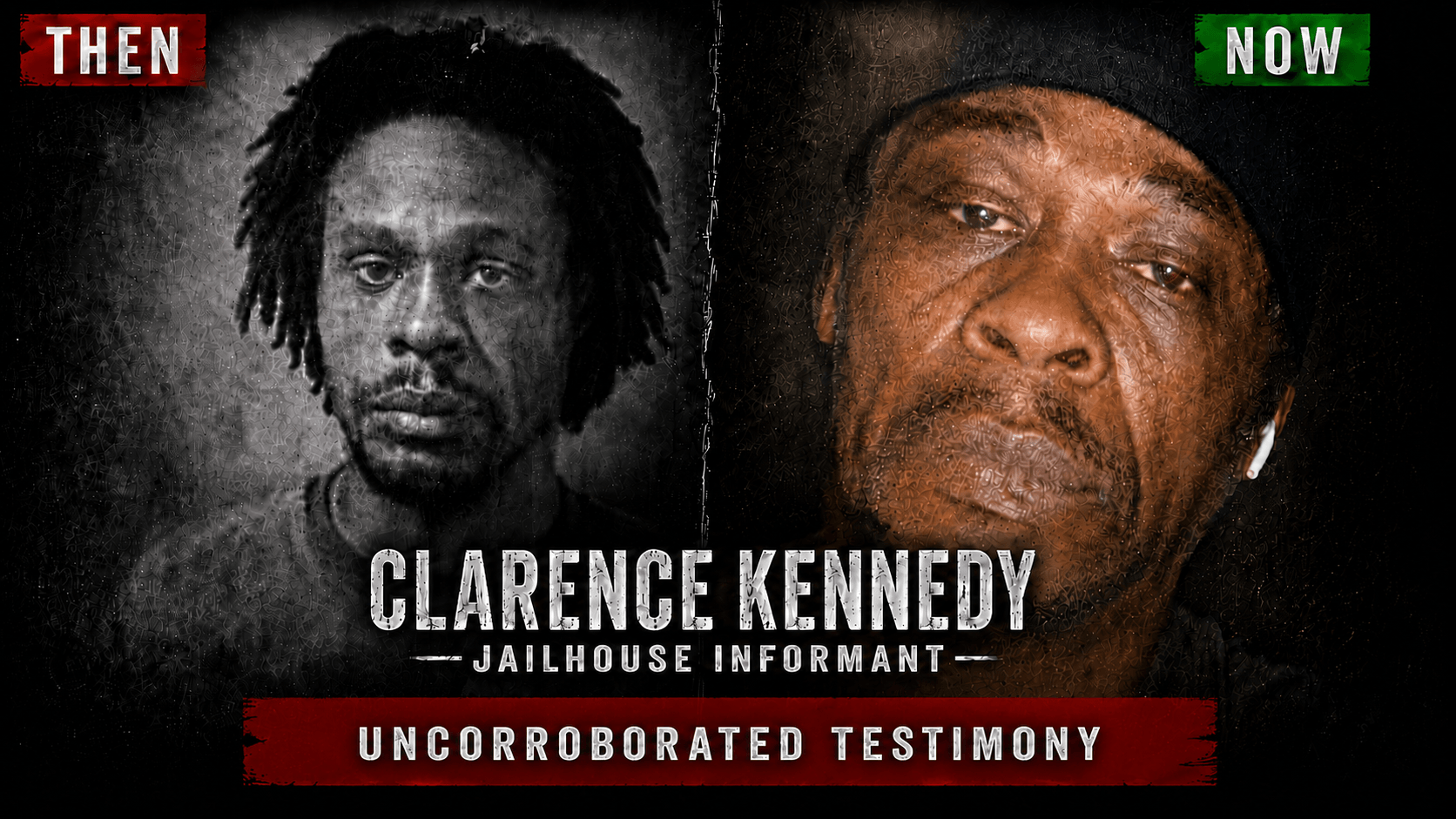
Clarence Kennedy was one of the three jailhouse informants whose testimony convicted Tony Hunter of the 2001 Greenwood Drive triple homicide — testimony the Louisiana Second Circuit called “the evidence that directly linked Tony Hunter with the crime.” This page is his evidence file: what he said, what he faced, and what the court records show he received. Everything here is cited; the side-by-side comparison of all three informants is on the informants page.
What he faced when he came forward
On April 18, 2001, Kennedy was charged with armed robbery (No. 01-F-0649) — a crime carrying a mandatory 10 to 99 years without benefit of parole, probation, or suspension. On June 8, 2001, he was separately charged with simple burglary of a vehicle (No. 01-F-0948). He had four prior felony convictions — unauthorized entry, possession of crack cocaine, receiving stolen things, and unauthorized use of a movable (twice) — meaning that as a fourth felony offender he faced a mandatory minimum of twenty years and up to 198 years if convicted as charged. (Bills of information; criminal history; Declaration of Robert M. Bloom ¶ 17.)
What he said
On August 20, 2001 — ten weeks after a television broadcast publicly named Mr. Hunter, and with reward money publicized — Kennedy asked to speak to a deputy. He said that in early August, from his cell in 10C, he had overheard Mr. Hunter arguing with inmate Glen Dale Nelson through the pod window, including statements about the killings. At trial he testified he heard Mr. Hunter ask Nelson “what did you say, because the police know too much.” Asked whether he heard any weapons mentioned: “No, sir.” He testified he heard no names — and moments later said Mr. Hunter “shot Levi, I mean, ah, Chico… in the room.” He could not recall the date; he said it was a weekday between noon and 3:00 p.m., and later that it was “late in the evening.” (Recorded statement; trial transcript at 602 and R. 2149–2164.)
He testified he had been promised nothing, received nothing, asked for nothing — that he came forward because it “really hurt him” to hear it. (R. 2151, 2162, 2164.)
What the records show he received
| Date | Event |
|---|---|
| 2002-01-30 | Gene Screen forensic report excludes Mr. Hunter from the scene, victims, and weapon; the State receives it February 2 |
| 2002-02 | Kennedy pleads to the reduced charge of first-degree robbery. Sentence: 25 years with 20 suspended. The simple burglary charge is dismissed. No multiple-offender bill is filed. |
La. R.S. 14:64.1 forbids suspending a first-degree robbery sentence — “without benefit of parole, probation or suspension of imposition or execution of sentence.” Twenty of his twenty-five years were suspended anyway. In January 2012, records show his post-sentence probation — also not permitted by the statute — was violated and extended rather than revoked. (Court records, No. 01-F-0649; clerk’s minutes; see the disclosure claims.)
At trial, the dismissed burglary charge was presented to the jury as a conviction. And a defense investigator reported that in February 2002 Kennedy described receiving “fifteen years in the way of help in this particular case” — which Kennedy denied on the stand. (Application for Post-Conviction Relief filed December 30, 2022, ¶ 112; trial transcript at 592, 605.)
The man he placed in the room
Kennedy testified that one other person was present: Jody Rucks, asleep on the bunk above him. Rucks swore in 2022 that he “would, and could never have slept through an argument loud enough to be heard through the window,” that Kennedy’s account of him is “a lie,” and that Kennedy told him “he would get less time for his crime if he was willing to testify against Tony Hunter.” (Affidavit of Jody Rucks, May 7, 2022, Exhibit C to the 2022 application.) No court has held a hearing on that affidavit.
The other half
The jury heard Kennedy’s prior convictions and his cross-examination; the Second Circuit affirmed, noting the jury “heard, in great detail, the prior convictions and sentences of the inmate witnesses.” Every post-conviction application raising these matters has been denied; a supervisory writ application filed July 9, 2026 is pending. No court has found that the State suppressed evidence about Kennedy. (Procedural history.)
Related: the three informants compared · Vaccara Comanche · Christopher Wiggins · Glen Dale Nelson · case timeline.