By Mrs. Eileen Hunter — about the author.
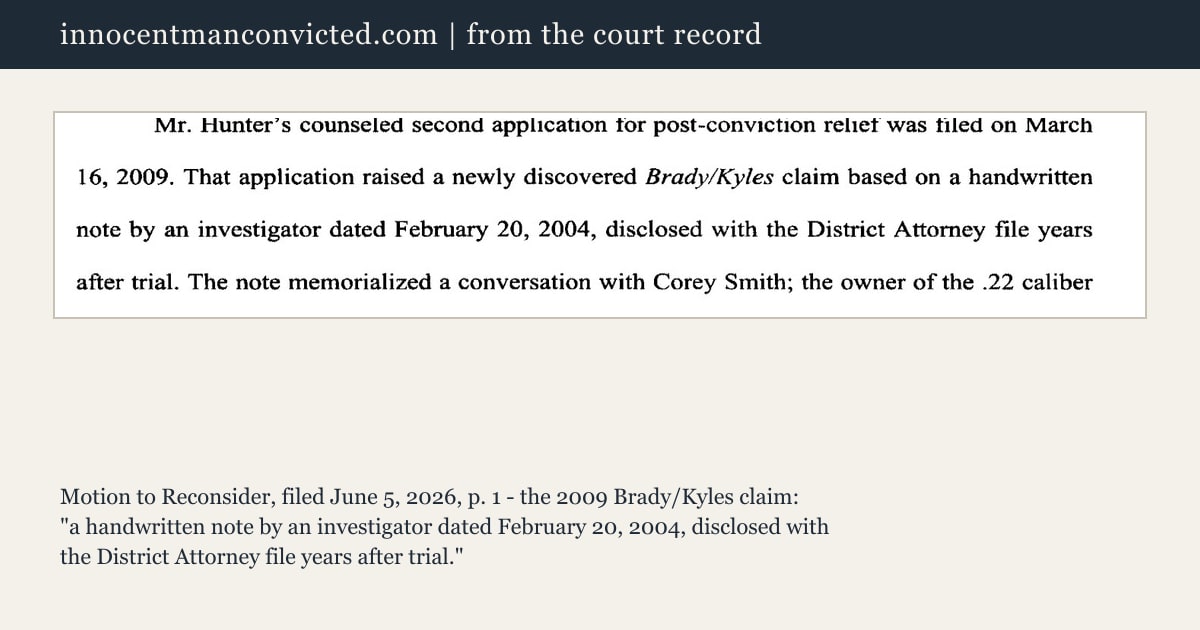
On February 20, 2004 — three days into the trial, which began February 17 — an investigator wrote a handwritten note recording a conversation with Corey Smith, the owner of the .22-caliber handgun recovered a week after the Greenwood Drive murders. As the note is described in Mr. Hunter’s application for post-conviction relief filed March 16, 2009, Smith said he had been arrested for fighting at the Library Lounge on January 11, 2001, had given his truck keys to a friend, Keith Norman, to move the truck, and noticed the gun and other items missing from the glove box the next day. The note recorded Smith’s belief that Norman had traded the gun for drugs. A police report verified the January 11, 2001 arrest at 1:07 a.m. (Motion to Reconsider, June 4, 2026, Procedural History; Application of December 30, 2022, Procedural History.) At trial, Smith had testified that the gun was stolen from his truck and that he filed no report because he did not have the serial number. R. 207. (The murder weapon file.)
The note was disclosed with the District Attorney’s file on March 12, 2008 — four years after the verdict. It became the basis of a Brady/Kyles claim filed March 16, 2009 in the Fourth Judicial District Court, Parish of Ouachita. The district court denied that application on July 14, 2009 without an evidentiary hearing. A later federal habeas petition was dismissed as time-barred, so no federal court has reviewed the claim on its merits. (Procedural history.)
The 2009 application described the note, in its own words, as evidence of “another, more probable suspect” that “would have turned the tide” at trial. That is the filing party’s allegation, and no court has ruled on it. This site reports the note and its two dates and draws no conclusion about any person named in it.
The other half: the State did disclose the note, in 2008, as part of its file. The trial court found the 2009 claim did not warrant a hearing, and no court has found that the note was suppressed within the meaning of Brady. The question the claim raised — whether a jury should have had it — has never been decided on the merits by any court, state or federal. (The disclosure claims · case documents.)
Leave a Reply