By Mrs. Eileen Hunter — about the author. Posted August 11, 2026.
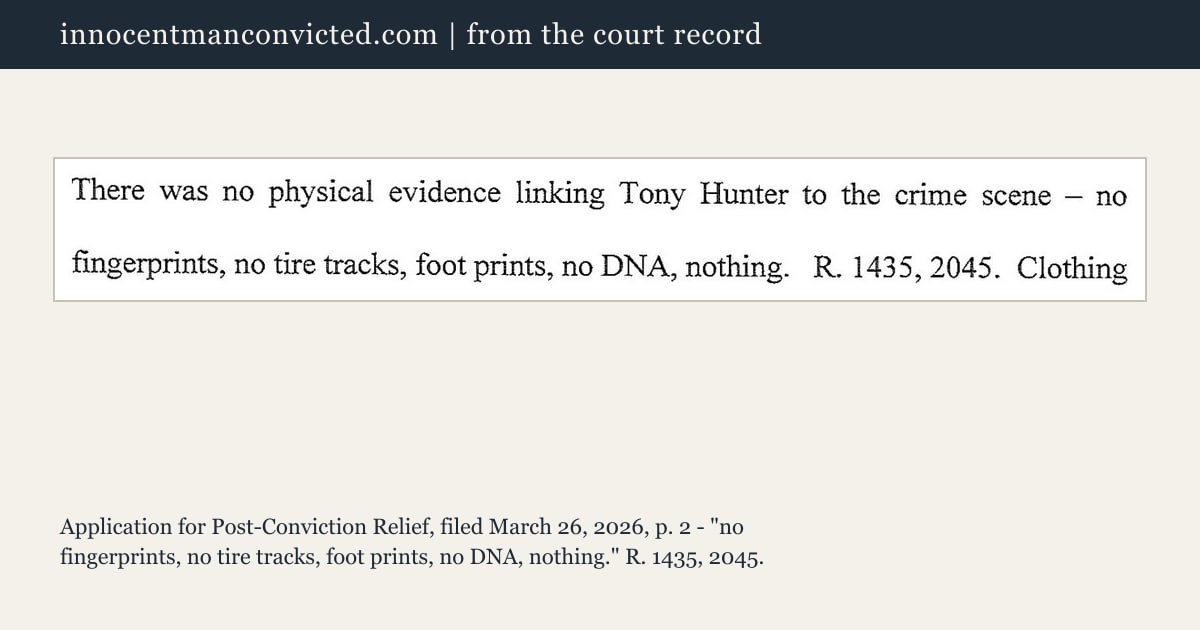
Jailhouse informant testimony is one of the most documented contributors to wrongful convictions in America — the Innocence Project has found it played a role in nearly one in five of the DNA exonerations to date. The March 10, 2001 triple murder on Greenwood Drive in Monroe, Louisiana shows why that statistic matters. Tony Hunter’s conviction rests entirely on the word of three men incarcerated with him at the Ouachita Parish Correctional Center: no physical evidence, no eyewitness — the Louisiana Second Circuit called the informants’ testimony “the only evidence that directly linked Tony Hunter with the crime.” State v. Hunter, 907 So. 2d 200, 204 (La. App. 2 Cir. 2005). So the reliability of those three accounts is the whole case — and one of the cleanest ways to test them is a simple question: what weapon did each man describe?
The weapon in evidence
The murder weapon identified at trial was a .22 caliber semi-automatic, recovered by Monroe police about a week after the killings, discarded on a median at a busy intersection — as the 2022 post-conviction application put it, “ditched as if hurriedly thrown out of a car window.” (Trial record; Application for Post-Conviction Relief filed December 30, 2022.) Keep that in mind as you read what each informant said.
Comanche: a .22 — hidden in “the same spot for years”
Vaccara Comanche told investigators, and testified, that he overheard Mr. Hunter discussing “the .22” with another inmate, Glen Dale Nelson, through a Pod 10 window — including that the gun was in “the same spot I been having for years.” (Recorded statement, July 20, 2001; trial testimony at 385.) Set that against the record: the .22 had been found by police on a public median within roughly a week of the killings — not resting in anyone’s long-term hiding spot. The 2022 application drew exactly this comparison. (Application, Dec. 30, 2022.)
Kennedy: no weapon at all
Clarence Kennedy claimed to have overheard the same window conversation. Asked at trial, “Did you hear him mention any weapons?” he answered: “No, sir.” He also testified he heard no names and no dates — and then, moments later, testified that Mr. Hunter “shot Levi, I mean, ah, Chico… in the room.” Asked to square that with having heard no names, he answered: “Any names? He didn’t say no name.” (Trial transcript at 602.)
Wiggins: a .38 and a 9 millimeter
Christopher Wiggins — the only one of the three who claimed Mr. Hunter confessed to him directly — testified that Mr. Hunter said he used “a .38 and a 9 millimeter.” (Trial transcript, R. 2139.) Neither matches the weapon in evidence. Context the record adds: Wiggins did not come forward — investigators sought him out; called to the stand, he at first refused to be sworn (“I ain’t testifying”), was held by court order, and testified the next day. He admitted asking the District Attorney’s Office for leniency on his sentence, and with five prior felonies he faced a life sentence if the State filed a multiple offender bill. It did not. In interviews with defense investigators in 2014 and again in 2022, Wiggins denied that Mr. Hunter ever confessed to him. (Trial transcript R. 2086–2087, 2131, 2135; investigator interviews, Exhibit I-3 to the 2022 application and the declaration filed with it.)
It was not just the weapon
The same three accounts also disagree on the date (Comanche: July 17; Kennedy: early August), the time of day (Comanche told investigators 8:00 or 9:00 a.m., then testified it was after noon), where Comanche was (hidden behind a blanket on a bottom bunk in his statement; sitting openly beside Nelson at trial), and who else was in the room. And the expert declaration filed in 2022 noted what was missing around all of it: “no video footage, recreation yard logs, or corrections witness to bolster the reliability of the alleged confessions.” (Declaration of Robert M. Bloom ¶ 17.) The full side-by-side comparison — every contradiction, with citations — is on the informants page, and the question of whether the window conversation was physically possible at all is examined on the window page.
The other half
The jury heard all three men testify and heard them cross-examined; the Second Circuit noted the jury “heard, in great detail, the prior convictions and sentences of the inmate witnesses and, likewise, heard the possibility for favorable treatment,” and it affirmed. Every post-conviction application raising these issues has been denied, and no court has granted relief. A supervisory writ application filed July 9, 2026 is pending in the Second Circuit. (State v. Hunter, 907 So. 2d 200; see the appeals page.)
We do not say in our own voice that any witness lied. We report what each man said, set the statements side by side against the record, and let you weigh them — the same way we hope a court one day will, at a hearing.
Leave a Reply